Tuesday, August 19, 2014

IDOL OF NEELA MADHAV - THE PREVIOUS FORM OF SRI JAGANNATH AS DESCRIBED IN SKANDA PURANA


Idol of Neela Madhav-The previous form of Sri Jagannath as described in Skanda Purana
- By Admin

According to Skanda Purana, Lord Jagannath (Vishnu) was first worshipped as Neela Madhav in an idol form in the Purusottama Kshetra before the installation of the wooden deities of Lord Jagannath, Balabhadra, Subhadra and Sudarshan by King Indradyumna. The centre of this Purusottama Kshetra was a  blue mountain  which  was surrounded by deep  jungles  from  all sides. The area of this Kshetra  stretched  five  “Kroshas” (1 Krosha=2 miles) into the great sea and two Kroshas into the sea coast. It was situated on the coast of the great ocean (Tirtharaja) and surrounded by the golden sands from all sides. There was a very high tree (Kalpa Vata) at the top of the blue mountain which retains its physical form even at the time of Pralaya (Dissolution of the Universe). Its length was 1 Krosha. It was full of tender leaves but devoid of any fruits or flowers. There was no change in its big shadow even after the sunset. In its western side there was a beautiful tank known as “Rouhina Kunda” which contained holy water in it. The tank had stairs going down inside it which were made from blue stones. Outside the tank there were four altars situated in its four directions and were made from crystals (Sphatik). The eastern altar at its centre contained an idol of Neela Madhav (Vishnu) made from blue sapphire. That place remained always cool due to the presence of the shadow of the Kalpa Vata. The idol of the Lord was eighty one fingers high and was placed on a golden lotus. The lips of the idol radiated a divine smile that was so beautiful that even the brilliance of full moon looked pale in comparison to it. The ear rings of the Lord were shaped like “Makara” (Crocodile like creature). The Lord’s neck was decorated with beautiful necklaces. The idol of Neela Madhav looked so beautiful that it seemed it would be a challenging task for even Vishwakarma (God of Architecture) to carve an idol like it. The idol had broad shoulders and four hands. On its chest the Lord wore the divine “Kaustubha Mani” (a Jewel). The reflections on the jewel looked enchanting and created an illusion of containing the fourteen heavens inside it. The idol wore pearl necklaces that extended up to the waist. It had a deep navel. It wore yellow dresses. The two thighs of the Lord looked like two pillars. The feet were round and very beautiful. The idol was decorated with bangles, arm bands and a head gear. In His four hands the Lord held Shankha (Conch), Chakra (Discus), Gada (Mace) and Padma (Lotus). At the left side of the Lord, Goddess Lakshmi (His consort) was playing Veena (a musical instrument). She was decorated with precious jewelry and was looking at the Lord. Behind them Lord Sheshnag stood covering their heads with his umbrella like hoods. In front of them Lord Sudarshan was standing in his divine form. Behind Lord Sudarshan, Lord Garuda stood with folded hands. The idol of Neela Madhav along with Goddess Lakshmi was worshipped by Gods like Brahma, Rudra and Indra. Anybody who had a glimpse of the idol, attained salvation instantly.

Once a pilgrim told King Indradyumna about Lord Neela Madhav and the glory of Purusottama Kshetra. After listening to him the King became interested to visit the Kshetra and have a glimpse of Lord Neela Madhav. This ultimately led to a series of events that resulted in the disappearance of the idol of Neela Madhav and appearance of a sacred wood from which the deities Lord Jagannath, Balabhadra, Subhadra and Sudarshan were carved out and installed in the Sri Mandir by the King himself.

 Source : http://puridham.com/Idol%20of%20Neela%20Madhav.htm

****************************************

RISHI MARKANDEYA'S DISCOVERY OF PURUSOTTAMA KSHETRA


Rishi Markandeya's discovery of Purusottama Kshetra
- By Admin

The glory of Puri Dham or the ancient Purusottama Kshetra is vividly described in the Utkal Khanda of Skanda Purana. The story of Rishi (Sage) Markandeya discovering this Kshetra at the time of Pralaya (Dissolution of the Universe) can be found there. The story goes like this-

Once at the time of Pralaya, when everything got submerged in the sea, Rishi Markandeya (who had been able to retain his physical body for seven kalpas) could not get a single piece of land to rest upon. So he became very worried. Nowhere could he get peace of mind. He was being carried away by the flow of water from one place to another. Finally, in this floating state he reached Purusottama Kshetra. There he saw the Akshay Vata and heard a child’s voice saying to him, “Markandeya! Do not worry; come to me and leave aside all your worries.”  The Rishi after listening to this strange voice (which he had never imagined of) got astonished. He thought, “In this all-engulfing water, this place (Kshetra) looks like a boat and in it this great Banyan tree is standing like a pillar. He began to wonder how this place had remained unaffected when everything else had been submerged in the water at that time of Pralaya, and who was calling him with such love and compassion. While he was thinking all these things and swimming in the water, the Rishi  saw Lord Vishnu and Goddess Lakshmi. He was very pleased and paid obeisance to them. After that he prayed to Lord by reciting hymns of His praise. Hearing this Lord Vishnu was very pleased and said to the Rishi, “O Sage! You are very worried and in distress. It is because you are ignorant of my form. You have done a lot of penance, but as a result of it you have only been rewarded with a long life span. Look at the child sleeping in the leaf of this Kalpa Vata. He is the ‘Kala Rupa’ of everybody. You can enter into his mouth and stay there comfortably.” The Rishi was astonished to hear this. Then he climbed the Banyan tree and saw the child form of Lord Vishnu. After that he entered His stomach through the mouth. Inside, he saw the fourteen cosmic worlds (Chaturdasa Bhuvana), gods, demi-gods, rishis, gandharvas, demons, seas, tirthas, rivers, mountains and cities. He also saw seven nether worlds (Patalas) and thousands of snake-women. He also saw the Sheshnag who was carrying the entire world on its head. He also saw everything that Lord Brahma had created during his creation of the universe. But he could not find the end of the stomach of the child. Finally he came out of the mouth of the child and again saw Lord Vishnu with consort Lakshmi. Then the Lord said to him, “O sage! This strange place (Kshetra) is my eternal abode. This is neither affected by creation nor by dissolution of the universe. It is also not bound by the laws of the universe. A person who enters into this place knowing my eternal nature and presence here, never takes birth again.” Then Rishi Markandeya prayed to the Lord to allow him to stay in that place. The Lord said, “I will stay in this place that gives salvation till the end of the Pralaya. After the Pralaya I will create a “Sanatana Tirtha” (eternal holy place) for you here, where you will worship Shiva ,my second form, and conquer death. Then the Rishi dug a tank by the help of the Chakra of Lord Vishnu in the Vayu (North-West) direction of the Banyan tree. Residing in this holy tank the Rishi worshipped Lord Shiva and conquered death. This tank is famous as the “Markandeyeswar Tank”. After taking bath in this tank and having a glimpse of the Shiva known as “Markandeyeswar”, one gets the benefit of conducting an “Ashwamedha Yagna”.

This Purusottama Kshetra spreads five kroshas into the great sea and two kroshas into the sea coast. It is surrounded by clear golden sands and a blue mountain. Lord Shiva himself resides here in form of Yameshwar to worship Lord Jagannath. By seeing and worshipping Him (Yameshwar), one gets the benefits of worshipping and seeing one crore Shiva Lingas.

Such is the glory of the Purusottama Kshetra. May everybody get the blessings of the Lord Jagannath and Lord Shiva in this holy place now commonly known as Jagannath Dham or Puri Dham.

source: http://puridham.com/Rishi%20Markandeya's%20discovery%20of%20Purusottama%20Kshetra.htm

****************************************

THE IMPORTANCE OF BAISI PAHACHA [ 22 STEPS ] IN SRIJAGANNATH TEMPLE

The importance of Baisi Pahacha [22 steps] in Sri Jagannath temple

By Prasant Kumar Mishra

The Baisi [22] Pahacha [steps] which connects the Lion’s gate (Singhadwara Gumuta) to the 2nd gate (Baisi Pahacha Gumuta) inside the temple has long since been considered an important part of the Sri Jagannath temple. Though the exact time of its construction is not mentioned anywhere in historical or puranic texts, legends say that it was built by a king named Bhanudev.  After passing through the Lions’ gate of the Sri Jagannath temple, one has to go up these steps and then pass through a 2nd gateway out to a courtyard from where one can get into the main temple. The length of each step is 70 feet, width 6 feet and height 6-7 inches.  A stone called “Yamashila” is engraved into the 3rd step, which the devotees must step on while going up the steps [it frees from the reasons to be punished by Yama] but must not step on the stone on the way back, since it takes away the merits of Sri Jagannath darshan.

Numerous holy activities are performed on these steps. It is said that during the car festival several gods and goddesses, demi gods, other heavenly entities, the souls of the ancestors [near pitrusila], chitragupta and Yamadootas [near Yamasila] descend upon these steps to witness the Pahandi of Lord Jagannath. Annual pinda daan [a special ritual in which food is offered to the ancestors] is performed on both the sides of these 22 steps. The ancestral souls are believed to be satiated by it.

Madan Mohan, the representative idol of Lord Jagannath, offers pinda daan on these steps to His ancestors – Nanda and Yashoda, Devaki and Vasudeva, Koushalya and Dasaratha] on chaturdashi tithi of the dark fortnight in the month of margashira. He also offers pinda daan to king Indradyumna [who had the Sri Jagannath temple built] and queen Gundicha, since they were childless.

On the day of Deepavali, people burn kaunria kathi [a bundle of light sticks] and show it upwards to illuminate the path of the ancestral souls. This ritual is called Badabadia [elders] Daka [call].

Believers of Jainism hold these 22 steps to be a symbolic representation of their 22 Tirthankars. Some say that these steps represent the 22 kinds of weaknesses and faults in human beings. Therefore, it stands to reason why some noble men, saints and vaishnavas took around 22 years in order to conquer these weaknesses and fault to make themselves eligible for a darshan of Lord Jagannath. So the scholars have named it ‘the steps of self-control’.

The small rough stone [the ones used for building houses] on the seventh step is called Preta shila or pitrushila. People leave Anna Mahaprasad [holy rice of the temple that has been offered to Lord Jagannath] on it for feeding the ancestors. This is believed to liberate the souls of the deceased.

Whatever might be the thoughts or interpretations behind these 22 steps, it is the faith in God which eventually counts.  A devotee gets a sense of fulfilment, if he trustingly puts on his forehead a speck of dust from the surface of the steps.

source : http://puridham.com/The-importance-of-Baisi-Pahacha-[22-steps]-in-Jagannath-temple.htm

****************************************************************

KING INDRADYUMNA'S ASHWAMEDHA YAGNA AND CONSTRUCTION OF FIRST JAGANNATH TEMPLE


King Indradyumna’s Ashwamedha Yagna and Construction of First Sri Jagannath Temple

- By Prasant Kumar Mishra

King Indradyumna of Avanti had travelled to Purusottama Kshetra with a hope to have a vision of Lord Purusottama (Vishnu). When he arrived there and experienced the sacredness of the place he decided to reside there for the rest of his life worshiping the Lord. He also decided to have a temple built there for the Lord.

Once the king took the decision to start the construction work, he sent for expert astrologers to do ‘the land treatment’ [to make the land ritually pure and fit for the construction of such a temple]. People well versed in the vedas, ministers, wise Brahmins and the experts in the field of Vastu also joined this activity. Soon the religious rituals were duly performed. Then the king Indradyumna sent for the kings of Utkal, Koshal and Kalinga. He urged upon them to go to Vindhya Mountain to have beautiful stones collected for the construction work. He also told them to take with them some people skilled in cutting stones from the mountain.

Then he ordered his men to send messages to all the kings of the world to come to Purusottama Kshetra with their armies, courtiers and priests as soon as possible. The order was immediately carried out and lots of kings those who were ruling over far and nearby places, hilly areas and plains, islands and plateaus flocked to the place with their armies, priests and lots of wealth.

The king Indradyumna was pleased to see them gathered at Purusottama Kshetra. “I have decided” said the king politely to the congregation, “to perform in this sacred place an Ashwamedha Yagna and thereafter have a temple built here too. I need your kind cooperation in this regard”. The kings were glad to assist the king in his effort.  They donated lot of things which would be needed during the Yagna and the building of the temple. Some of the things were money, gold, precious stones, pearls, blankets, deer skin, beautiful mattresses, diamonds, elephants, horses, and several kinds of eatables.

The king was glad to see the collection for the task ahead. When he became sure that the wise men of different kinds such as sages, renunciates, penitents etc had gathered and the ingredients to be used during the Yagna were ready, he asked his priest to look out for a suitable spot for the Yagna. The priest first sent Brahmins to find a suitable place for the Yagna and then he himself left for the place with some architects. Soon they found a village where the fishermen lived and had a Yagna Shala built there. Hundreds of palatial rooms were also built around the Yagna Shala. The entire platform where the Yagna was to be performed was decorated with precious stones. The doors to the rooms were really big. The king took great care about the logistics of accommodating the invited royalties. They were offered rice, different kinds of cuisines, sugarcane juice and milk. The most dignified and wise Brahmins got the warm welcome they deserved.

In the meanwhile the king got the message that the construction of platform for the Yagna was complete. The king was thrilled to hear the news of it. He started with offering meals to Brahmins. Every day when around 1 lakh (one hundred thousand) Brahmins finished eating their meals, trumpets blared like thunder. Thousands of people had gathered and they were from different parts of India. There were rivers of ghee, milk and curd and they were given to the people present there. The king also donated millions of bulls and cows with gold capped horns and brass milk cans to Brahmins well versed in the Vedas. They also received precious stones, mattresses of deer fur, expensive clothes and even diamonds. No one starved, no one got less, and no one was dissatisfied. Even gods above were surprised to see the initial success of the Yagna.

And then the king asked his sons to find a most befitting horse for the Yagna and take it around the country. He announced that the Yagna was going to continue until God appeared.

And finally all his effort bore fruit. After the successful completion of the Yagna he was blessed to have a vision of the Lord. Soon after that he concentrated on having a most beautiful temple built for the Lord and in due course Sri Jagannath temple came into being.

Reference
Brahma Purana
Source : http://puridham.com/King-Indradyumnas-Ashwamedha-Yagna-and-Construction-of-First-Sri-Jagannath-Temple.htm

***************************************************************************

NILGIRI HILL - THE DOOR TO HEAVEN

Nilgiri Hill – the door to Heaven

- By Prasant Kumar Mishra 

The importance of making pilgrimages to holy places is known to all. However, the divine favor a person is sure to get by visiting the Nilgiri Hill is doubtlessly rarest, since it gives liberation from the worldly bondage and sometimes with the grace of Lord Purusottama, it even qualifies a person to go to heaven alive. King Ratnagriva, whose pious life earned him the merit to see this otherwise invisible Hill called The Blue Mountain or Nilgiri, was one of those extremely fortunate people who went to heaven without having to shed the mortal coil.

Fascinated by the stories about the Nilgiri Hill, king Ratnagriva decided to go there with his queen and minister and a Brahmin who guided his way. However they could not see the hill as it remains invisible until one has attained a certain spiritual level and pleased Lord Purusottama. The king was certainly a virtuous soul and had been living a strictly spiritual life. So, he decided to please the Lord by singing His glory and his determination bore fruit. He finally won The Lord’s favor to see the holy hill. An overwhelmed king Ratnagriva, along with the four other people - the Brahmin, the queen, the minister and a saint called Karamba-began ascending the hill during an auspicious moment called Vijay. The hill top looked picturesque, laden with unfamiliar but magnificent trees. Nestled in the hill-top was a most beautiful temple, the walls of which were plated with gold. Lord Brahma was believed to have been coming there every day to worship Lord Purusottama and offer him food deserving to please Him.
All the five of them entered the temple. They saw there a golden throne studded with precious stones, on which stood the idol of Lord Purusottama in his four handed form.  At His side were courtiers such as Chanda, Prachanda and Vijay ready at His service. All bowed to the Lord and later they bathed the idol while chanting vedic mantras and did other rituals of worship. They also put sandal wood paste on His body and robed him with beautiful dress. Then they offered him food. And at the end, all of them started singing the glory of Him, together. The Lord, pleased with their sincerity and devotion, said “O king! Let me make it known to you all that I am the Supreme Soul, beyond the material world and nature. Eat the Prasad soon and you will get the four- hand form and achieve the ultimate end of life.”
The king and the others ate the holy Prasad and a few minutes later a divine chariot decorated with hundreds of small bells appeared there. They made their obeisance to the Lord and got on to the chariot. Each of them had four hands which bore signs of Sankha, Chakra, Gada and Padma. Within a few moments the chariot sored up in to the sky and vanished into the blue and the five of these holy people went to heaven alive!!
Reference
Padma Purana

source : http://puridham.com/Nilgiri-Hill-the-door-to-Heaven.htm

**************************************

THE STORY OF LORD PURUSOTTAMA AND THE BHILS

The Story of Lord Purusottama and the Bhils
- By Prasant Kumar Mishra

         According to Skanda Purana, the idol of Lord Neela Madhav [Lord Purusottama], an earlier form of Lord Jagannath used to be worshipped by some tribal people and their chieftain Vishwavasu. However, the Purana does not give an account of when and how the tribe became associated with the worship of the idol. In one of the chapters of Padma Purana there is a short description about Bhils [a tribal group] which may have a remote or direct association with Vishwavasu and his tribe. The story below relates how these Bhils got the opportunity to visit the Nilgiri Hill and the Idol of Lord Purusottama.

As per the story, King Ratnagriva of Kanchi had a long cherished desire to make pilgrimages to extremely sacred places. One day he saw a Brahmin hermit in his dream and just the day after, a very thin Brahmin appeared in his court. The king requested him to recommend some pilgrim sites that ensure freedom from the cycle of birth and death to those who visit them. The hermit told him about several sacred places and at last he said about the Nilgiri Hill [Blue Mountain], the holiest place on earth and the extraordinary archer Bhil tribe he found living there. The Bhil people had four hands and the Brahmin related to the king how the tribe got its divine physical form. He said exactly what the Bhils had told him about it.

The Bhils lived on the fruits and nuts from the forest. Once one of the Bhil boys, while picking berries, wandered into the area where the hill was and climbed on to the top. There he was surprised to find a unique temple. The walls of the temple were of pure gold and studded with precious jewels. Out of curiosity, the boy entered inside and saw the idol of Lord Purusottama. He also saw some other gods lost in singing prayers, some were dancing in ecstasy and some others were guffawing in strange ways. He also witnessed that the gods worshipped the idol of Lord Purusottama and offered food to Him. After the gods left, the boy came out of his ambush and found some grains of cooked rice lying on the floor. Evidently, it was the Prasad that had fallen on the floor during the worship. The boy ate the Prasad and had a darshan of Lord Purusottama. And then, immediately after that, much to his surprise, he discovered that he had grown two more hands on his body! He returned home and recounted the story to the shocked Bhils. Then the Bhils also went to the temple. They saw the idol, ate the Prasad and got transformed into the four handed form.

At the end of the story, the hermit added that he himself had gone to the top of the hill to see the idol of Lord Purusottama and acquired the aforesaid unique physical attribute.

source : http://puridham.com/The-Story-of-Lord-Purusottama-and-the-Bhils.htm

******************************************************

Thursday, June 19, 2014

INVASION OF THE TEMPLE OF LORD JAGANNATH AT PURI

Invasions of the Temple of Lord Jagannath at Puri
BY: SUN STAFF 
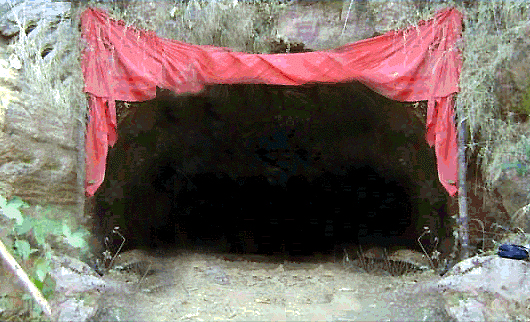
The impenetrable caves at the foot of the Trikut Hills at Sonepur-Gopali,
where Their Lordships hid during the Raktavahu invasion

Oct 06, 2011 — CANADA (SUN) — Adaptation of an article by Abhimanyu Dash, in two parts.
Throughout the ages, the temple of Lord Jagannath at Puri has been invaded and plundered eighteen times, as recorded in the annals of history. The temple was a lucrative place of wealth for invaders to plunder. To non-Hindu invaders, the temple was a good place to display Zihad (religious war). To loot its property and profane idols were motives behind every invasion.
Owing to a series of inroads on the temple of Lord Jagannath, the Triad were exiled in various regions of Orissa. The invasion of Raktavahu on the temple of Lord Jagannath is considered to be the first one, as per the record of the Madalapanji, the temple chronicle. Andrew Stirling reproduced the description of Raktavahu's invasion from the Madalapanji in his writings in 1822. The story of Raktavahu's invasion recorded in the Madalapanji indicates that he had defeated King Subhanadeva of Orissa.
During this invasion the Deities were taken away to Gopali, a village in Sonepur, and kept underground. Prof. K.C. Panigrahi has identified Raktavahu with Govinda-III, the Rastrakuta King of Deccan, and Subhanadeva with Subhakaradeva-I of Bhaumakara dynasty. As evidence, Prof. Panigrahi has taken the help of the Hindol plate of Subhakaradeva-III of 839 AD, and Sanjan plates of Amoghavarsha. It is stated in the Sanjan plates of Amoghavarsha that the Rastrakuta king Govinda-III (AD 798-814) conquered Kosala, Kalinga, Vanga, Dahala and Odraka. Under Govinda-III the Rastrakutas became invincible everywhere and there is therefore no doubt that they invaded Odraka (Orissa).
Based on the Hindol plate of Subhakaradeva-III, Prof. Panigrahi states that the Rastrakuta King's invasion of Orissa took place during the reign of Subhakaradeva-I. Govinda-III, alias Raktavahu, approached Puri with his army from the sea. The King of Orissa fled from the city with the Deities of Lord Jagannath and His Associates lodged in a cart. Their Lordships reached the Western frontier of Sonepur and were buried at a place known as Gopali. After 146 years Yayati-I, the Somavamsi king, got the Deities dug out, made new Deities, built a new temple at Puri, and enshrined them there. Gopali, a village with a shrine of Jagannath, still exists at a distance of 16 miles from Sonepur. [1]
Yayati-I, after bringing back the Triad, performed navakalebara of the Deities at Puri because of the degraded conditions, with the help of servitors. The citadel of the Lords was fixed in the temple, measuring 38 Hatas (cubits; at present the temple of Lord Nrusingh) beside the Mukti Mandap in the precinct of Sri Jagannath Temple. That is why king Yayati is regarded as the ‘Second Indradyumna' in the annals of history, owing to this restoration. [2]
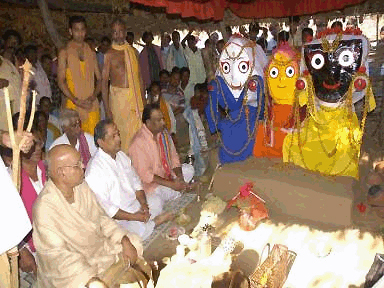
Lord Jagannath Deities today at Gopali, Sonepur

During the period of invasion of Raktabahu, the Deities were worshipped at Gopali in Sonepur. At present the place is at Chhalia mountain in Kotsamali. The Deities returned to Shrikshetra during 814 A.D. and 819 A.D. [3]
The second invasion on the temple of Lord Jagannath was waged by Illias Shah, the Sultan of Bengal in 1340 A.D. during the reign of Narasinghadeva-III. His defence system in the northern frontier of his empire was very weak. The military organization of the Fort of Raibania in north Balasore was not strong. The commandants of the fort were bribed by Illias Shah.
Narasinghadeva III felt insecure and kept his queens in the Giridurga near Simachalam. He prepared militarily to defend his empire of Utkal. In spite of his military arrangement to safeguard his empire, Illias Shah suddenly attacked the temple of Jagannath in 1340 A.D. He made havoc among the religious minded people of Puri. The people ran in panic to save their lives. The soldiers of lllias Shah killed the people mercilessly and looted the wealth of the temple. Narasinghadeva III was unable to protect his people and the temple, although he successfully hid the triad Deities in an unknown place, and no harm was done to Them.
During the reign of the Ganga King Bhanudeva III, the third invasion took place in 1360 A.D. by Feroz Shah Tughluq, the Muslim ruler of Delhi. At the time of invasion Bhanudeva III was not in his capital. When he got the news of invasion, he returned to Puri with his army and found no Feroz Shah Tughluq. Feroz went back Delhi via Jajnagar (Jajpur). Nothing is known about his desecration of the Triad and plunder of the temple. But scholars believe that he had thrown the Deities into the Mahodadhi (Bay of Bengal). This view is not supported by historical evidence.
The fourth invasion was launched by Ismail Ghazi, the commander of Allauddin Hussain Shah, the Sultan of Bengal in the year 1509 A.D. The Suryavamsi King Prataprudradeva was the ruler of Orissa, and he was in the South at the time of invasion. The priests of the temple sailed the Triad to the forthills of the Chadheiguha Pahada in the Chilika Lake. On being informed, King Prataprudradeva rushed back from Deccan and drove away Ismail to the point at Huguli in the Bengal. [4]
The fifth invasion was launched by Muslim invader Kalapahara in the year 1568 A.D., during the reign of Mukundadeva Harichandan, the Chalukya King of Orissa. Kalapahara was one of the army assistants of Sulaiman Karrani, the Afghan Sultan of Bengal. In this expedition Bayazid, the son of Karrani was the commander of the Bengal army. He was assisted by Sikandar Uzbeg and Kalapahara. The reasons for Karrani's attack on the temple of Lord Jagannath was Mukundadeva's entanglement in the political diplomacy which created much bad blood between the two. Firstly, Mukundadeva gave political shelter to Ibrahim Sur, who was a great enemy of Sulaiman Karrani. Secondly, Mukundadeva committed another offence by exchanging envoys with the great Mughal emperor Akbar. In 1566 A.D., Akbar sent envoys to the court of Mukundadeva and Mukundadeva in exchange sent a Hindu ambassador named Paramananda Ray to the Court of the Mughal emperor. [5] Akbar was a great enemy of Sulaiman Karrani. These two offences committed by Mukundadeva incurred great displeasure in the mind of Sulaiman Karrani, which paved the way for his Orissan invasion.
Kalapahara, the Assistant Army General of Sulaiman Karrani led the expedition against Mukundadeva of Orissa in 1568 A.D. On the contrary, Mukundadeva sent Raghubhanja Chhotaraya to resist the army of Kalapahara,but failed. Raghubhanja proved a traitor, and Kalapahara occupied Cuttack. So Mukundadeva surrendered before the Muslim army of Bengal. In the meantime, Ramachandra Bhanja, the commandant of Sarangagarh Fort (Baranga) rebelled against Mukundadeva. The latter was killed at Gohiratikara (near Jajpur) because of the two traitors Sikhi and Manai, who were the generals of the King of Orissa. Ramachandra Bhanja was also killed by the invader.
Ramachandra Bhanja, who declared himself the King of Orissa, finally proved himself as a traitor behind the assassination of Mukundadeva, the last Hindu king of Orissa. In the Madalapanji, this traitor has sometimes been described as Ramachandra Bhanja and sometimes as Ramachandradeva. The latter name seems to be more correct. [6]
After occupation of the forts of Cuttack and Sarangagarh, Kalapahara successfully led his army to Puri to demolish the temple of Jagannath. The servitors of the temple got information of the fall of Katak (Cuttack) to the hands of the Muslims. They hid the triad, Lord Jagannath, Baladev and Subhadra in an island inside the Chilika Lake, as stated in theMadalapanji. The Deities were hidden underground at Hastipatna in Parikuda, identified with Chhapali, Khepali and Hatipada. Kalapahara could easily know about the secrecy of the hidden Deities. He carried the triad from Chilika Lake to the bank of the river Ganges on an elephant, where he burnt them. Bisher Mohanty, a Vaishnavite saint, followed Kalapahara and managed to bring back the ‘Brahmas' to Kujanga Gada, keeping Them inside a mridanga. Later on the ‘Brahmas' were brought to the Gopal Temple of Khurda Gada in 1575 A.D. by King Ramachandradeva. Subsequently the ‘Brahmas' were placed in the Deities. The Deities were brought back to the temple of Jagannath from Khurdagada.
It is stated in the same chronicle that Kalapahara destroyed the great temple of Jagannath up to the Amalakasila, and defaced the Deities. It is difficult to ascertain the truth of the statement, but to us it seems that the temple was not pulled down or razed to the ground, though the Deities were damaged and disfigured as much as possible. There is no archaeological evidence to show that the temple was rebuilt at any time. The original temple as built by Chodaganga has come down to us, though the carvings on the outer faces of the temple have been damaged or disfigured. [7]
A tradition in Bengal avers that Kalapahara was earlier a Brahmin by caste. His name was Raju, alias Kalachand. He fell in love with Dulari, the daughter of the Sultan of Bengal and married her, but he wanted to retain his religion. The Hindu society refused to accept him. He came to the temple of Jagannath at Puri for expiation, but the priests rebuffed him. This made him reactionary and revengeful. He took a vow to exterminate Hindu religion, deities and temples. This theory is only traditional, and does not have any historical authenticity. Kalapahara was an Afghan; Kalapahara was a title used by many Afghans. A nephew of Bahalul Lodi bore this name. Prof. P. Mukherjee observes that "The Muslim chronicles conclusively prove that Kalapahara was a full blooded Afghan and not a Brahmin renegade."[8]
Sulaiman Karrani died in 1572 A.D. followed by several invasions and plunders on the temple of Lord Jagannath at Puri by his successive rulers, namely Bayazid, Daud, Kuya Khan and Kutlu Khan Lohani, who ruled over Orissa one after another.
After them the sixth invasion was jointly waged on the temple of Jagannath in 1592 A.D. by Suleman, the son of Kuthu Khan and Osman, the son of Isha (ruler of Orissa). They havocked people at Puri and killed them mercilessly. They desecrated the images of the great temple and plundered its wealth. By such action, the invaders violated the treaty earlier signed between Isha and Raja Mansingh in 1590 A.D. Mansingh the Mughal general finally suppressed the militant activities of these two Muslim invaders in 1592 A.D.
During this time Ramachandradeva, the Bhoi dynasty ruler of Khurda, took the leadership of feudatory rulers of Orissa, who joined their hands against the Mughal rule. During the reign of Purushottamadeva of Bhoi dynasty, Mirza Khurum, the commander of Islam Khan, the Nawab of Bengal invaded Puri in 1601 A.D., which is considered to be the 7th attack on the temple of Lord Jagannath. The servitors of the temple could smell of it and shifted the triad Deities to village Kapileswarpur near Puri in vessels, on the River Bhargavee. The Deities were kept in the Panchamukhi Gosani Temple at Kapileswarpur. Dola festival was celebrated in that temple. Thereafter the Deities were shifted to Dobandha — Pentha where Their Lordships passed eight months with shital bhoga offerings. As per the description of theMadalapanji, Mirza Khurum invaded Puri temple during the time of Dola Yatra. He found no Deities in the temple and so looted the underground treasury.
Hasim Khan, the Subedar of Orissa waged the eighth invasion on the great temple of Lord Jagannath at Puri. This time Purushottam Deva was also the King of Khurda. He shifted the deities to the Gopal temple at Khurda before Hasim's arrival at Puri. In order to satiate his master Jahangir, the then Mughal emperor, Hasim Khan plundered the temple of Jagannath at Puri. The Deities were returned to the temple at Puri Dham by the King in 1608 A.D.
The ninth invasion on the temple of Jagannath was launched by a Hindu Rajput, Jagirdar Kesodasmaru in 1610 A.D. Kesodasmaru was serving under Hasim Khan. He was a friend of Jahangir. He came to Puri in disguise of a pilgrim accompanied by his faithful soldiers, without military uniform during the celebration of the car festival. They entered into the Jagannath Temple and occupied it, converting the temple into a fort. At that time the Triad were in the Gundicha Temple. Kesodasmaru plundered crores of treasury of the Temple of Jagannath.
Unfortunately, the king of Khurda Purusottamdeva was absent at Puri as chherapahanra(sweeping the chariots) was performed by Mudirath on behalf of the king. The king immediately rushed to Puri with his Paik soldiers, chariots, cavalry forces, elephant forces, arms and ammunitions to punish Kesodasmaru. The Paik soldiers jumped into the premises of the temple with the help of chariots, through the four gates. They fought against the Rajput soldiers who were looting the wealth of the temple. Kesodasmaru ordered his soldiers to counter attack the Paik army. The Rajput soldiers decided to bind up clothes tightly with bamboos and used oils to ignite the clothes, which turned into fireballs, and threw them against the chariots to burn. The chariots very quickly caught fire and burnt to ashes. So many Paiks died.
The King was unable to face the invaders, who looted the wealth of the temple, then went away. During the course of attack, the Deities remained in the Gundicha Temple for eight months. They were brought back to the Temple of Jagannath by the help of Vimana.

FOOTNOTES:

1. K.C. Panigrahi, "The Bhaumakaras", in History of Orissa, Cuttack 1995, pp. 78-79
2. Rabindranath Pratihari, "Exile", in Cultural Heritage of Odisha, Puri Dist.(ed) G.Mohanty (et al), Vol. XII, part-III, Bhubaneswar, 2010, P-188
3. Ibid, p. 199
4. Ibid, p. 189
5. K.C. Panigrahi, "The Chalukyas", History of Orissa, Cuttack, 1995, p. 242
6. Ibid, p. 243
7. lbid, p. 244
8. Ibid, p. 245
Source: 'Orissa Review'