Monday, September 2, 2013

WITH BABA TO BADRINATH

With Baba to Badrinath
The sacred Himalayan regionThere is a distinct qualitative difference between Bhagavan Baba and all the other spiritual leaders one can think of. Baba himself was once asked about this, and he replied, “I have descended from the level of God to the level of man in order to uplift man. Others are humans trying to raise themselves up to the level of god.” Despite this emphatic declaration, in the olden days, devotees often used to request Baba to take them on a pilgrimage to holy places. And the embodiment of compassion that He is, Swami often yielded to such prayers.
One such historic visit was to the holy shrine of Badrinath, nestling in the majestic Himalayas, the abode of Lord Shiva, the home of sages, and the destination of pilgrims through the ages.
We turn to the account left by revered Kasturi, of that trip.
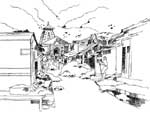
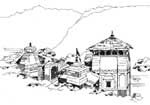
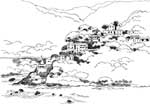
Kedarnath
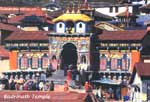
BadarikashramThe visit to Badrinath was first mooted by Baba in 1958 at a Bhajan session held on the sands of the Chitravathi river. He then said that He would take devotees to the place where He was doing Tapas [penance]. We were wonder-struck because that was the first time we had ever heard of Tapas associated His Earthly Career…. I was a bit confused…..
The visit became a certainty in 1961, and plans were ready; devotees who would accompany Baba had also been selected. Baba greeted them in Madras on 7th June, and sent them by train to Delhi. He announced then that He would fly to Delhi the following day and be there to personally receive the party on arrival.Rudraprayag
The train reached Delhi about six hours late, but Baba was there, shedding comfort and consolation with His smile and motherly-attention.
On the following day, the party left for Hardwar, where they were joined by Dr. B.Ramakrishna Rao, Governor of Uttar Pradesh. He too planned to visit Badrinath in the company of Bhagavan Baba.
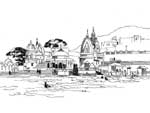
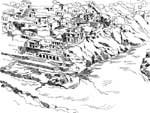
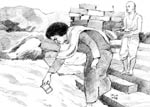
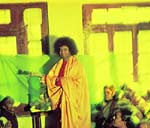
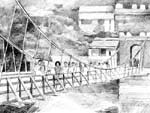
HardwarOn Sunday, 11th June, on the lovely little lawn behind the Dam Koti Bungalow, Hardwar, tucked in between the Ganga Canal on one side and the Ganga river on the other, Baba addressed in the stillness of the night, the group of devotees He has gathered together for the Badrinath Yatra. He said,Devaprayag “Tomorrow we are leaving for Badri, a place consecrated by the Tapas of eminent sages and saints and of Sri Narayana Himself. You are all very fortunate indeed, for you are proceeding with the Manifested Form to the Unmanifested Form! There is a holy aura, a spiritual vibration, that pervades such sacred places and even Divinity acquires a new glory, as it were, when it is seen in the background of that aura. So, be ever alert to make the best of the rare chance that you have won by the accumalation of merit through many births. Be friendly, helpful and loving to all; repeat always the Name of the Lord; never loose courage or joy”. He disclosed that the Crossing the Lakshman jhoolaplace was called Badarikashram, and that Lord Narayana was supposed to be doing Tapas here.
I began to see light, and the doubt that assailed me on the Chitravathi sands three years ago about ‘Sri Sathya Sai and Tapas’ melted away in a blaze of joy!Walking up the mountain slope
Baba then described to the group, the Shrine at Badrinath, how the Narayana idol appears often as a Lingam, sometimes as the Buddha and sometimes as Sakthi. He also gave details of the various subsidiary idols that are worshipped there. He spoke of the five Lingas brought by Sankaracharya from Kailasa and installed at Badri, Puri, Sringeri, Dwaraka and Chidambaram; of the Four Vedas which he revived by appropriate ritual, the Rig at Puri, the Yajur at Sringeri, the Sama at Dwaraka and the Atharvana at Badri. He put everyone into the pilgrim mood of expectancy and elevation, of Love, brotherhood and service.
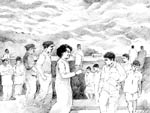
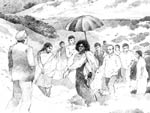
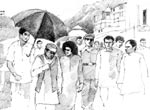
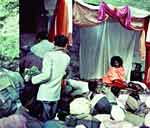
By the side of a holy riverMost members of the party had assembled at Madras on 7th June at the Yathiraja Kalyana Mantapam, Alwerpet and had reached Delhi on the 9th; there, they were joined by others from as far as Calcutta and Bombay and Lucknow. They had all arrived at Hardwar on 10th and proceeded to Rishikesh to see the holy spots there and to visit institutions like Swarga Ashram and Githa Bhavan and Paramartha Nikethan. On the 11th, they had witnessed the Evening Harathi to Ganga Matha at the Brahma Kund, a ceremony which was sanctified that day by the Presence of Baba at the sacred place, with H.E. B.RamakrishnaIn Badri on the way to the temple Rao, the Governor of Uttar Pradesh. Their Excellencies performed Harathi to Baba himself there, as a preliminary to their own Badri Yathra, along with the Bhakthas chosen by Baba.
From Hardwar to Badrinath, a distance of nearly 182 miles, every inch of the ground is saturated with history, myth and legend, all woven around the heroic endeavour of Tapas, whether by gods or men. Hardwar itself is the scene of Daksha Yagna and of the penance of the Seven Sages. At Rishikesh, Lakshmana performed Tapas. There is a Vyasaghat a few miles away where Vyasa did penance and at On the way to the river in BadrinathDevaprayag, the meeting place of the Alakananda and Bhagirathi rivers ( and what a marvellous Tapas it was, that of Bhagiratha which induced the heavenly Ganga to descend on Earth!) Sankaracharya did penance and installed a Siva – Parvathi Lingam! At Bilva – keda nearby, Arjuna went through rigorous asceticism to acquire from Siva the weapons for the up – holding of Dharma. At Srinagar, Sri Rama is said to have engaged in penance to realise Himself in the Siva Form! At Karna – Prayag where the Mandakini coming from Kedarnath joins the Alakananda, Karna prayed for years and years to get a vision of Surya. At Rudra Prayag, Narada did Tapas in order to become the Singer of Divine Glory and he won from Siva the Veena that plays upon; Nandaprayag, 33 miles away, is associated with the hermitage of Sage Kanva immortalised by Kalidasa. Rajarajeswari herself is said to have engaged in Tapas on the Saranyavathi river bank to acquire Siva as Her Lord; while, on the banks of the Virahi Ganga, Siva is described as having done penance to win Dakshayini back as His consort! At Bhavishya Badari on the way, Agasthya performed Tapas. At Joshimath, (elevation 6100 ft) Narada by His Tapas succeeded in getting possession of the Ashtakshari manthra which is the key to salvation; Markandeya performed austere penance here and Sankaracharya established a Mutt to revive and foster the Sanathana Dharma.Taking water from the river in Badrinath
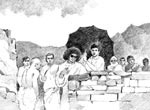
Beyond Joshi Math we have Pandukeswar, reminiscent of the Tapas of Pandu, Sesha – Dhara reminding us of the fact that the thousand tongued Sesha too was a Muni so that he might realise the Lord and Hanuman Chatti where Hanuman proved His superior prowess to the second of the Pandava Brothers; finally at Badrinath itself ensconced between the Nara and the NarayanaBlessing the pilgrims of Badrimountains, at the foot of the snow diademmed Nilakanta Peak ( the Queen of the Himalayas, 21640 ft high ) the Puranas declare Narasimha came to shed His ferocity and Narada, Agni and Indra did penance. King Visala by His Tapas there won the distinction of Badri being Badri Visal; King Ghantakarna by his austerity there won the honour being the watchman of the Lord. Uddhava is doing Tapas there even today by the special command of Sri Krishna. And the Lord Himself is depicted as in Tapomudra, in keeping with the elevating and inspiring mood of the entire Himalayan area for miles around and is worshipped by Gods for half the year and by men during the other half.Displaying the Lingams that He created at Badri
The Ganga from Hardwar to Devaprayag and the Alakananda from there onwards for over 138 miles keep inseparable company with the pilgrim, now coming up near the road in a surging swelling stream, now gliding deep down the yawing canyon, murmuring along a silver thread. At first, the roar of the waters is frightening but gradually the river becomes a friend and companion and the thunder of its waves is distinguished as but the recital of the Name of the Lord or of Om, His verbal symbol. O! What shall be said of the high voicedThe Badri idol, the nethra lingam and the thousand petalled LotusAlakananda, the multimillionaire heiress of Kubera’s wealth, gaudily tripping the rocks, from Alakapuri, his capital? And what of the tiny tributaries: the milk white Ksheeraganga. Neelaganga, the blue, Ghrithaganga the oily, Kanchanaganga the golden, Keerthiganga the famed, Rishiganga the ascetic, Virahiganga the forlorn! Consider all the hot springs at Badri which the God of Fire spouts forth in obedience to a command by Narayana Himself in order to rid Agni of the sin of being an Omnivorous Glutton.The Badrinath shrine
What again shall be said of the magnificent ‘manorama’ of snow capped peaks and glaciers, enormous cliff’s enervating gradients escarpments and precipices, cascades and springs, and the multicoloured flower carpets that are spread by nature in every little vale? Indeed, every step of that road is a stride towards God!
To be lead by Baba along this Holy road is indeed a unique piece of good fortune and when one looks back on the much talked of calamities that lurk round every curve, the landslides and the land slips, the unheralded breaches and blockades, the bitter cold, and the pouring rain, the strain and the exhaustion, one feels specially blessed because Baba’s Abhaya Hastha was present always to stem the fall, to prop up the slip, to ward off the rain, to warm up the air, to inspire the drooping and refresh the tired.
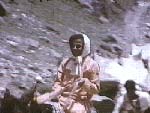
The Divine horse riderThe caravan of cars, jeeps, buses and trucks left Hardwar on Monday, 12th June at 8AM and reached Devaprayag at noon. The bath at the confluence was a refreshing and exhilarating experience. Srinagar, the ancient capital of the Kings of Garhwal, was reached in the afternoon and we halted there for the night. The people of Srinagar organised a programme of Pahari and Tibetan dances depicting the simple hilarity of the hardy tribesmen and Baba, Their Excellencies and all of us appreciated their earnestness and sincerity. On the 13th, the party left at Sunrise for Joshimath, 86 miles off, taking breakfast on the way at Rudraprayag, bathing at the junction of the Mandakini and Alakananda at Nandaprayag and taking lunch at Pippalkoti at about 3PM. The night was spent at the sacred Joshi math.
Bardinath was beckoning us from just beyond 18 miles! ……. Eighteen miles along a narrow five foot ‘road’ ofThe golden bilva leaf manifested by Babarubble and stone, trodden into smoothness by million of pious feet; of sudden climbs and steep declines; of ‘Danger from Falling Stones’ announced on boards enroute! The rapture of ravine, cliff and snow ever before the eye, the cheer of the torrent ever in the ear! Broad glaciers bravely descending down the mountains into the river bed itself and even mischievously lying across the pilgrim path! Streams of pilgrims from every corner of this country crossing each other with a gleam in the face when the password, Jai Badri Visaal, is uttered! Pilgrims resolutely pulling themselves along on foot, or pathetically perched on ponies trotting on the perilous edge of the precipices! Long lines of men, mules horses, yaks and goats loaded with beds and bundles, boxes, baskets and bags belonging to the pilgrims and silk and sandalwood, scents and sweets, flour, flowers and fruits for the shops at Badri Town!
All these give the Sacred Road a sublime sathsang atmosphere wherein the Lord is experienced as a constant and comforting Companion!
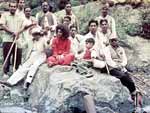
With the chosen onesOn the 14th morning, conveyances were booked, the mules and horses were loaded, and the party started off in high spirits, to Lam Bagar eleven miles away, where it was decided to halt for the night. Baba and a large number of devotees walked the entire length of the road. Oh! How can I adequately describe the tenderness with which He encouraged everyone along that arduous road, advising one person to get into a dandi, another to ride a horse, a third to check the pace, a fourth to rest awhile, keeping everybody’s enthusiasm in good trim by a timely quip or joke or pleasantry, or sometimes even by means of the Divinely created Vibhuthi itself.
From Lam Bagar, it was an exhausting climb and the devotees succeeded in persuading Baba to ride a horse; but, to their great disappointment, He resumed His walk within a few moments. Badrinath was reached in the late afternoon on the 15th , and the party occupied the Gujarathi Dharmasala, very close to the temple.With the holy Ganges
On the 16th, Baba gave Darsan and blessings to a large number of officers and citizens and members of the Temple Committee and He attended the evening Arathi, in company with their Excellencies. Later, Baba inaugurated the X – ray unit at the Badrinath General Hospital. The first ‘patient’ to be screened was the doctor himself; he declared joyfully, “Babaji! You are seated in my heart!” Baba said , “The X – ray can’t reveal it; but, it is a fact, Doctor, I know it”. A supreme moment indeed, in the history of that hospital and the life of that doctor!
17th June was a Day of Days, a Day that will be enshrined in the memory of everyone in the party, for years and years. In pursuance of His Mission of re-infusing spiritual efficacy in all Holy Places where men congregate for acquiring peace and joy, a Mission which took Him recently to Ayodhya, Kasi and Prayag, Baba that day re –invigorated Narayana worship at Badrinath, by means of a unique cermony, whose significance is beyond our tiny understanding!
During the morning Abhishekam to the idol of Badrinarayana, while Baba was inside the temple facing the shrine, about 8.15AM, Baba mysteriously materialised a four armed Narayana icon with Sankha, Chakra, Gada and Padma, about 12 inches , perhaps sublimating in that form the Divine Essence of the Narayana Tejas before Him. He also created a charming thousand petalled ‘gold’ Lotus, and before the wonder of the people around Him could express itself in an awe striken gasp, He waved His hand before the Shrine and, lo, there was a Jyothirlinga in His palm, which He placed on the shining Lotus. Baba came away to the Dharmasala with the devotees and the large number of officers and citizens of Badrinath. Their Excellencies also soon joined the gathering.
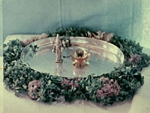
Materialising a ‘silver’ Abhisheka Vessel full of holy water from Gangothri itself (as He announced), Baba Himself performed Abhisheka to that translucent Nethra Lingam. He had graciously taken the Linga round to everyone and made all to wonder at its quit effulgence and at a clearly visible Eye that was somehow incorporated in it. Devotees recited Sri Rudram, Purushasuktham and Narayana Suktham, while Baba was pouring the sacred water on the Lingam. Then, Baba created 108 miniature Bilva leaves or rather replicas of that holy leaf, in ‘gold’; they fell in a lightning shower from His Palm on to a silver plate. He again waved His Hand and this time, O Blessed moment, 108 actual ‘thumme’ flowers fresh with even the touch of the morning dew, fell from that Divine Palm! With these, Baba directed Dr.B.Ramakrishna Rao, presumably on behalf of all assembled to do Puja to the Linga, the Ashtottara Puja, as mentioned in the Sastras. After Puja, Baba collected the Abhisheka Ganga and gave a share of it to each one, Himself pouring it into the mouth with His own merciful Hand.
Needless to say, the Lingam, one of the Five, which according to Baba, Sankaracharya brought from Kailasa, and which he installed in a sacred spot in the shrine to vivify the Badarikasram returned to the place from which Baba had drawn it for this epoch making ritual of re invigoration. The Lotus and the Icon, He granted to the devotees; the Bilva leaves of ‘gold’ He gave to members of the party, as mementoes of the Momentous Day, for being duly worshipped by them.
About 12.30PM, the same day, Baba condescended to come to Brahmakapal, where the devotees had arrived to offer oblations to the pitris (forefathers). He advised everyone to pray for their ancestors and departed relations, in a spirit of faith and sincerity. Every member of the party had a rare good fortune of paying off the debt to the departed in the immediate presence of the Lord Himself!
Then Baba went down to the Alakananda and took from the surging torrent a glass of water, but, lo! The glass held also a lump of Vibhuthi with the mark of Pranava on it and the til essential for ancestral rites! He poured the water on to the palms of the devotees who were handicapped by disqualifications form partaking in the Pinda Pradan, asking them to offer that water instead! Surely, the manes of all who shared in that day’s Brahmakapal ceremony are thrice blessed!
In the evening at 6PM., the Badrinath Temple Committee accorded a welcome to Baba at a formal ceremony at the Temple premises, which His Excellency Dr.B.Ramakrishna Rao also attended. About 3000 thousand pilgrims and citizens attended and the precincts were packed to capacity. Baba spoke of the five Lingas brought by Sankaracharya and of the sanctity of Badri. He asked everyone to decide for himself where real happiness lay and rigorously to pursue the path to win that happiness. He emphasised that Prema is the very essence of Bhakthi, the light with which the Lord (who is Premaswarupa) can be seen and realised and understood. He asked the citizens of Badri to appreciate the ordeals, trails, tribulations and expenses undergone by the pilgrims, the illnesses and accidents which they had braved, and the faith which heartened them from the first step to the last. He advised that they should learn from the pilgrims a part of their faith in Badri Narayana and treat the pilgrims with greater kindness and brotherliness. Dr.B.Ramakrishna Rao translated Baba’s Telugu speech into Hindi.
The Secretary who thanked Baba said that the announcement, regarding the 5 Lingams, and Badri being repository of one of them will thrill everyone and will instill greater faith in Badri in the hearts of every Hindu.
In the night Baba arranged for the feeding, on a truly lavish scale, of all the mendicants around the Temple of Badrinath and He distributed a blanket each ( or its equivalent in money) to more than five hundred peple. No wonder they all joined in the chorus of thanksgiving and cheered “Bhagavan Sri Sathya Sai Baba Ji Ki Jai”.
On the 18th, about 9AM, Baba and the devotees left Badri and, reached Lam Bagar for lunch, halting for sometime on the way to bless the organisers of a Yajna named Sri Rama Krathu. The next day, Joshi Math was reached and the return journey by bus and car was undertaken from there on Tuesday, 20th.
It is worth noting that Baba walked back the distance from Badrinath to Joshi Math and on the second day, he was among the earliest to reach the destination, ascending the steep heights of the Vishnu Prayag Joshi Math mountain road, without the least sign of tiredness.
Baba had said during the forward trek that the rains shall not come until the party was back in Rishikesh and true to His command, the rains held back, until the ‘caravan’ was within 20 miles of Rishikesh when the party got the first drops of drizzle!
It must be mentioned that while nearing Rishikesh, Baba miraculously anticipated, by a few minutes, a landslide which came down across the road causing even a slip, but only after all members of the party had safely come across the doomed spot. A party of more than a hundred devotees, mostly old and not quite sturdy could go through all the tossing and twisting in the buses and all the tramping and climbing of the hills, in strange climes and with strange foods and come back hale and hearty, as per schedule, only through the Ever present Grace of Bhagavan Sri Sathya Sai Baba.
We were all back in Hardwar on Wednesday 21st June and we left on 22nd for Dehra Dun, from where we had to entrain for Delhi. Baba encouraged all the devotees to collect Gangajal from Brahmakund so that they could take it to their homes. He had a kind word and an encouraging smile for everyone. He came to every bus when the party was on the point of leaving. He blessed everyone and commanded them to share their joy with others and to life thereafter everyday of their lives as real pilgrims towards the seat of Narayana. With our eyes full of tears of joy, we sat in the bus, unable to speak, for when the heart is full, the tongue is silent.
Baba left for Naini Tal from Hardwar; He spent three days there with Their Excellencies, but they were, inevitably busy days full of interviews with a large number of high officers and dignitaries, who had come for Baba’s Darsan. Baba also visited the ‘Githa Sathsang’ established by Swami Vidyanandaji. A welcome address in Hindi was presented to Him at the Sathsang. He addressed the members on the need for practicing the path of Sadhana laid down in the Githa.
In the discourse Baba said, “Mere scholarship is just a burden, without putting what is studied into action. It is only that part of it which is put into practice, felt and experienced that becomes one’s undisputed possession”. Baba pointed out, “The Githa was propounded to every one who is afflicted with the delusion and ignorance. Arjuna was just a representative of struggling mankind, at the crossroad of conflicting duties, without the Light necessary for discovering the right path”. “In the 18th Discourse, Krishna asks Arjuna, “Has all these been heard by you, with one – pointed attention ? Has the delusion caused by ignorance of the Reality been destroyed?” This shows that the purpose of the Githa is to destroy Moha, or Delusion, which is the result of misunderstanding the unreal as real, the transitory as the permanent, the source of sorrow as the source of joy” Baba concluded. He said that the Githa was a Universal textbook of Spiritual Science which could be studied and practised by people of all climes and creeds. The only qualification needed was a yearning for the higher ideals and an earnestness to discover the source of lasting joy.
Baba returned to Delhi on the 26th and emplaned for Madras on the 27th. He reached Madras just in time to meet the members of the party who arrived by train from Delhi the same evening, and to send them with His Blessing to their respective homes.
Baba reached Puttaparthi at noon on 3rd July and the Bhakthas there welcomed Him with great Joy. On the 4th, Baba gave the devotees a graphic description of the journey and an inspiring account of the Three Eventful Days at Badri. He wanted that everyone should draw inspiration from the devotion and faith of thousands of old, decrepit and poor pilgrims who brave the dangers and disasters of the road every year, just to get a glimpse of the Lord in the Badri Narayana Form. He said that those who visit Holy Places must prove in their daily lives that the holiness has entered their hearts and changed their habits and thoughts for the better. He said that Sankaracharya installed the Narayana idol at Badrinath, and every one must install the Name of Narayana in the Shrine of the heart. Then, He gave every one the Theertha of Gangothri with which He had performed the Abhisheka at Badri as well as the prasad of Badri itself.
That was the blissful consummation of the Badri Yatra for all.
With the Manifested, we proceeded to the Unmanifested! At every step among the Himalayas we experienced the Prema of the Lord whose was with us! At every turn, His Grace guarded and guided us.
May He be our Guard, our Guide and our God forever!


Volume - 2 Issue - 5


source :http://media.radiosai.org/journals/Vol_02/05March01/02_Cover_Story/baba_to_badarinath.htm


**************************************************************************************************************************
Radiosai Journal - PSN 2004
 

Thursday, August 1, 2013

THE LEGITIMACY OF THE MAHARAJA OF PURI RELATING TO FEUDATORIES AND THE CAR FESTIVAL

The Legitimacy of the Maharaja of Puri Relating to Feudatories and the Car Festival

Abhimanyu Dash

The association of the Kings of Odisha with the Jagannath Cult became very close after King
Anangabhima Deva III had recognized Jagannath as the overlord and state deity of Odisha in 1230 A.D. He claimed to reign under His supreme overlordship. The feudatory Kings of the Gajapati Maharaja took active participation in preparation of the cars for the festival. They actively provided wood, iron and ropes for smooth functioning of the Car Festival at Puri. Not only the feudatories of the Maharaja of Puri spiritually rendered cooperation but also militarily and politically provided assistance.

Before 15th Century the role of Gajapati Maharaja in the Car Festival was very casual or limited. The situation changed under the Suryavamsi Kings in the 15th century. The first two kings of this dynasty Kapilendra Deva and Purusottama Deva were usurpers. In 1434 A.D. Kapilendra Deva overthrew the last legitimate King of the Ganga dynasty. His son Purusottama Deva usurped the throne inspite of the legitimate claim of his elder brother. Both the kings needed a special legitimation of their rule which they gained through an intimate association with the Jagannath Cult of Puri. Kapilendra Deva called himself a Servitor (Sevaka) of Jagannath. He threatened his opponents in most of his inscriptions with the wrath of the “Lord of the Universe”. He threatened others to attack on the basis of treason (droha) against the Lord of Puri. After the rule of Kapilendra Deva, his son Purusottam Deva established himself on the throne of Gajapati. He poured gifts over the God (Jagannath) and priests of Puri. Furthermore, he was the first King who cleaned the cars (chherapahamra) to prove his association with the ritual of the Jagannath Cult.

Even today the Car Festival cannot start before the King or his representative (Mudarasta) has sprinkled (chera) the three cars with water and cleaned (Pahamra) them with a broom. From 17th century source it is known that the King after finishing the ritual Chherapahamra put a silk – covered pillow (Pata muchula) on his head and symbolically pushed the cars from behind, thus starting the Car Festival. However the Chherapahamra of the cars of Puri became the main source of legitimacy of the later kings of Khurda and Puri. Now a days the grand ceremony of sweeping the cars remains the most important royal duty which bears the proud name “Gajapati Maharaja Seva”. It makes the ‘Maharaja’ of Puri indispensable to the Car Festival even now though they have lost all their ancestral territory around Khurda in 1804 A.D. A few years before they lost their remaining royal privileges.

The imperial Gajapati of Odisha lost his empire in 1568 A.D. due to extermination of Mukunda Deva by Muslim armies of Bengal. Ramachandra Deva I after being recognized by Akbar as the king of Khurda with semiautonomous status established his legitimate relation with the Jagannath cult of Puri. He ruled from Khurda but the capital of the new province remained at Cuttack under the Mughals. The Kings of Khurda were usually called as the Maharaja of Puri. But during the reign of Jahangir one Hindu Rajput, Keso Das Maru who was in service of Jahangir attacked and looted the Jagannath temple at the time of Car Festival of Puri. The Gajapati King of Khurda stubbornly opposed and used his military Paik forces but was defeated. The temple cars were also destroyed. After the Gajapati king of Khurda lost his military and political power during the fight he turned his attention to Puri. He systematically enlarged his influence and control over the Jagannath cult during the peaceful reign of Sahahjahan. Since then an intricate set of temple-palace relations had evolved which became the main basis for Khurda’s influential position during its power struggle with the various feudatory states and the Muslim Governors of Odisha. The car festivals played an important role during this struggle for power and legitimacy. The feudatory Kings also played significant role during this period. With the exception of a few iconoclasts, the Muslim Governors of Odisha were genuinely interested in enlarging their control over the Car Festival because of the pilgrim tax with a view to increasing revenue. The Gajapati Kings of Khurda, on the other hand, used the Car Festivals to maintain their influential position at Puri. The Car Festivals afforded an excellent opportunity to display their role as successors to the Imperial Gajapatis. Their power enhanced as “First Servitors” of Lord Jagannath before the feudatory Kings of Odisha.

In the first quarter of the 17th century the Gajapati Kings of Khurda issued ‘royal letters’ (Chhamu Chitau) to the feudatory kings of Odisha granting them certain privileges in the Jagannath cult in order to gain their loyalty and political support. These letters established Khurda’s ritualpolitical relations with the other feudatory states of Odisha.

Gajapati Maharaja Virakesari Deva reigned Khurda for a long period from 1737 A.D to 1793 A.D. During his reign Khurda’s political power collapsed because of the conquest of Odisha by the Marathas in 1751 A.D. The Marathas of Nagpur deprived Virakesari Deva of his relationship with the feudatories. The Marathas also took over the administration of the Jagannath temple of Puri in 1760 A.D. Virakesari Deva desperately tried to maintain his leading position among the Hindu Kings of Odisha. For this purpose he issued ‘royal letters’ permitting feudatory Kings to contribute to the yearly construction of the Cars. He also rewarded them with special privileges in the Jagannath cult during the Car Festival.

He requested the Kings of Dasapalla to provide wood for the construction of the three
cars which was important in his power struggle with the Marathas. The Marathas were compelled to acknowledge this power of the king of Khurda. Since the Maratha period it was the privilege of the Kings of Dasapalla whose territory comprised large forests at the southern bank of the Mahanadi to provide wood in lieu of tributes. This privilege was also acknowledged even by the English East India Company in its treaty with Dasapalla in the
year 1804. According to the treaty of the year 1804 Dasapalla had to pay no peshcus or tribute or payment. In cases of severe drought when the waterway on the Mahanadi became unpassable, the Kings of Khurda had to organize an alternative. For this purpose Virakesari Deva sent a royal order to the superintendent of the Jagannath temple on 03.03.1749 stating that the timbers required for the construction of the cars of the deities could not come up to the Atharnala bridge. So people should be deputed to Banpur for procuring the required timbers. These timbers were cut from the forests on the boundaries of the two states named Ghumsur and Athagarh in southern Odisha. Saris (turbans as sign of honour) were sent from the temple store for the two chieftains through the royal messenger.

Similarly iron necessary for the construction of the cars was procured from the feudatory kings of Dhenkanal and Talcher in Central Odisha. Thus on 01.05.1744 Virakesari Deva issued a royal order (hukum) to the temple officers at Puri to “send saris and mahaprasad” to the Kings of Dhenkanal and Talcher for supplying the iron for the construction of cars. Both the places produced iron locally.

Ranpur, another feudatory state in Central Odisha and an important ally of Khurda used to
provide ropes for constructing and dragging the cars. On 9.4.1749 a letter was issued from the
palace for the construction of the Nandighosa Car the simuli ropes will be brought. So the royal messenger named Jamai Atibuddhi should be deputed to Narendra the King of Ranpur with Sari and Mahaprasad from the temple store. The father of Virakesari Deva, during his reign had rendered Ranpur’s economic and military support for which he received several important privileges in the Jagannath cult. The Khurda King had exempted tax to Ranpur’s monastery at Puri. In return, Ranpur’s Kings donated valuable gifts to the temple treasury. One King of Ranpur state was appointed bodyguard of Jagannath by performing the honourable “dagger and sword service” (chhuri khanda seva) in front of Jagannath.

Other Chiefs and Kings of Odisha received special privilege during the Car Festival as a reward for their support to the Khurda kings. They were permitted to serve Jagannath with a special Chamara fan during the Car festival. In 1760 Virakesari Deva granted this privilege to the King of Tigeria of Central Odisha. In 1778 this privilege was also extended to the Mahanta of the Chikiti monastery at Puri. Chikiti was an important princely state in South Odisha. Its monastery at Puri played the role of “ambassador” at the Court of Gajapati Kings of Odisha.

An incident occurred that the King of Parlakhemundi in South Odisha attempted to capture the Gajapati Kingship through occupation of the Car of Jagannath and performance of the royal ritual of the Gajapatis of Khurda on the Car. The King of Parlakhemundi claimed to be the descendant of the imperial Gangas who ruled over Odisha until 1434 A.D and not accepted Khurda’s claim to Gajapati Kingship. On 12.7.1753 Jagannath Narayan Deva of Paralapatana (Parlakhemundi) had come together with his brother to see the return Car festival from the Gundicha temple to the main temple. He sat on his royal seat of the elephant alongwith a Nagara drum and flag staff. The elephant was placed in front of Jagannath’s Car and Narayan Deva with his brother ascended the Car from the back of the elephant to have Darsan. The presents offered by them were taken by the Daitapati priests. During the Darsan of the great Lord on the Nandighosa car a necklace fell from the holy body of the Lord Narayan Deva asked to be given the necklace but in this moment all priests hid the necklace, gave him Tulsi and Prasad (offerings) and sent secretly the divine necklace to the King. On the next day the cars reached the Lion’s Gate of the temple of Jagannath towards the close of the night. Being dressed in royal robes Narayan Deva and his brother sat on the Car. On the same day all the priests had a confidential discussion because of the Darsan of the King of Parlakhemundi and his brother in full royal dress on the car and the possibility of their entering into the temple in royal dress. It was dawn before the discussion was over. Because these two people while sitting on the Car demanded to be allowed to discharge the duties of the King during the time of the ceremonial return of the deities from the cars into the temple, this ceremony did not take place. Consequently the three incense offerings (dhupa) were performed on the cars and Narayan Deva went away. On the next day the deities stayed on the cars. After the three incense offerings had been performed the ceremonial return of the deities to the temple began at 10.30 P.M. Wearing a royal turban and a belt Narayan Deva followed the great Lord and walked majestically into the temple.

Narayan Deva returned to the temple the next day in royal dress together with the Maratha
general Mahana Singh to worship Jagannath. But due to the passive resistance of the priests of the Jagannath temple he did not succeed in his attempt to perform royal ritual. Thus none accepted him as the legitimate Gajapati King. As a compromise he was allowed to enter the temple in full royal dress.

The generous distribution of privileges to the feudatories by the King of Khurda during Car
Festivals and unsuccessful attempt of the King of Parlakhemundi to capture the Cars prove that the Jagannath temple had a definite political role to play at the time of the Car festivals. On the other hand, the Car Festival safeguarded the legitimacy of the Kingship of the Gajapati Maharaja.

Owing to the ritual policy of the Kings of Khurda, the Jagannath cult of Hindu royalty
spread to the Capitals of the former feudatory states of Odisha during the 18th and 19th centuries. Several new capitals were constructed during the 19th century with a Jagannath temple and a palace in their centre with a Grand Road leading to Gundicha hut outside the town. Those new capitals built for the purpose were in the States of Tigeria, Baramba, Ranpur and Daspalla etc. They were imitating the model of Puri where the present palace was constructed at the Grand Road near the Jagannath temple in the middle of the 19th century. In most of the capitals of the former feudatory states of Odisha, Jagannath’s Car festival became the main event. The Cars usually imitated the Cars of Puri.

References :

1. K.B. Tripathy, “The Evolution of Oriya Language
& Script”, 1962.
2. L.Panda, (compiled), ‘Record of Rights of Shri
Jagannath Temple’, Vol.III, in “The Orissa Gazette
(Extraordinary)”, Cuttack, 1955.

3. H.Kulke, “Kings without Kingdom. The Rajas of
Khurda and the Jagannath Cult, South Asia,”
Vol.-IV, 1974.

4. H. Kulke “Kings and cults – State Formation and
Legitimation in India and Southeast Asia”, New
Delhi – 2001.

5. The Madalapanji (Rajbhoga).

6. S.N. Rajaguru, “History of the Gangas”, Vol.II
Bhubaneswar, 1972.

7. Kedarnath Mohapatra, ‘Khurudha Itihasa’,
Cuttack, 2009.

Abhimanyu Dash, Lecturer in History, Surajmal Saha
Mahavidyalaya, Chitrakar Sahi, Puri - 752001.

source : Odisha Review June - 2012

****************************************

Sunday, July 28, 2013

LORD JAGANNATHA AND SAINT BALARAM DAS

Lord Jagannatha and saint Balaram Das.


Saint Balaram Das was a great devotee of lord jagannatha and he was such a lover of lord jagannatha that he was just feeling it that beyond jagannatha there is nothing other in this world. Once the famous saint who was the writer of Dandi Ramayan (Ramayan in Oriya language) got an idea to make a visit to lanka, which according to the Ramayan was once the capital city of the demon Ravana. He told this to lord Jagannatha and at the time of night he went to visit lanka along with lord Jagannatha. Jagannatha during that visit   told him to hold his gold jhari(A typical ornament of gold). After finishing their visit Balarama das forgot to return the ornament. But at the morning the priests found it that the ornament has been stolen by somebody and when Saint Balaram Das came with that he was accused as the thief and was taken to the court of the Gajapati king. But latter Gajapati found it by taking proves from lord jagannatha that Balaram Das is not guilty and he is a great devotee of lord Jagannatha. So he paid due respect to him.

But Balarama Das was in love with a prostitute called jamuna Bai. When once he was with The prostitute he found it that it was the very day of car festival and the chariots are going to be pulled. He ran to the Chariot of lord jagannatha but the priests found it that he has just returned from the prostitute and the turmerics and the lipsticks of the prostitute are still prevailing there on him. So the priests beated them and he returned.
With tears on his eye Balaram das went near the sea(Bay of Bengal) and   there he prepared three chariots on sand for the two brothers Jagannatha,Balabhadra  and their sister Goddess Suvadra.Praying with tears he told it that if you are truly my God then the chariots there will not move and you three will come to this sand chariots of mine.

Suddenly all the three chariots of the car festival stopped and  after a huge effort the people were unable to move them even one inch. Everybody got worried so finally the Gajapati king got the message and he along with the priests on fasting started praying to lord Jagannatha. Then Lord jagannatha appeared on his dreams and told them everything and told that I cannot tolerate the insults of my devotees. If you pay proper respect to Balaram das and will beg pardon to him then only along with him I will return to the chariots made by you. The king did accordingly and the chariots started moving along with his great devotee Balaram Das.

source (Extract from) : http://www.orissadiary.com/news.asp?id=20028
 - See more at: http://www.orissadiary.com/news.asp?id=20028#sthash.mUEPRU9C.dpuf

****************************************

KING DIVYA SINGHA DEV AND LORD JAGANNATHA

King Divya Singha Dev and lord Jagannatha


It was 12.07.1972 and it was the famous Car festival of that year. Prior to this the managerial aspects of Srimandira (Lord jagannatha's temple is called as Srimandira) were under direct control of the Gajapati king who is regarded the first servant of the lord Jagannatha. But prior to this year due to the improper managements of the Gajapati king the Government of Orissa removed the power from them to get involved with the managerial aspects of Srimandira and appointed an A.D.M. (Additional District Magistrate) to look into the matters of Srimandira Management.

Gajapati remained silent with this decision of Government of Orissa. The A.D.M. was a very punctual person but he had a wrong notion that man is arranging this car festival for the lord so to complete it in a proper manner the lord should come to the chariots in proper time. Within 10A.M. of that morning lord Balabhadra and Goddess Maa Suvadra came to their chariots according to the schedule. But when it was the case of lord Jagannatha it became impossible to bring him to the chariot. Because the more the people were trying more they were becoming unsuccessful to do that wanted. Those who tried to use force they got injured. Finally the people there including the ministers and the chief minister got harassed, as they had no way out. But at very moment king Divya Singh Dev was present there as he had to perform the cleaning ceremonies there in the chariots. He finished his job in the chariots of Lord Balabhadra and Maa Suvadra and came towards the chariot of lord Jagannatha but till then people were not able to lift lord Jagannatha to his chariot so he started weeping the king in his weeping voice told that "oh, lord this festival is yours and we all are just the facilitators please pardon on us please move to the chariot." And surprisingly this few words of the Gajapati king Divya Singh Dev created an astonishing result and the idle, which was unimaginably heavy before, became as light as a flower. And finally the lord went to the chariot probably on his smiles he was giving the message to the people and Government of Orissa that "My servant is every thing for me I will only listen to him not to anybody other else and I am not guided by anybody other, rather all the others of the world are guided by me as I am the all mighty.

source (Extracted from ) : http://www.orissadiary.com/news.asp?id=20028
 - See more at: http://www.orissadiary.com/news.asp?id=20028#sthash.mUEPRU9C.dpuf

****************************************

Saturday, July 27, 2013

ANGADA SINGH AND SRIJAGANNATHA

Angada Singh and Sri Jagannath

Durga Madhab Dash


Sri Jagannath is the all-merciful Lord. He is the ocean of profound divine love and fathomless
compassion. One cannot guess when He crowns. His devotees with mercy fulfilling their desires.Sri Jagannath is said to be the enigmatic Lord of the Universe. Scriptures say that He represents all religions. He is adored in myriad ways representing the various forms
of gods in Hindu religion.The devotees of Sri Ram say that He is Sri Ram incarnate on earth.
Vaishnavites say that He is worshipped in the wooden form as the incarnation of Lord Krishna. Buddhists describe Him as the Buddha, the enlightened Divine Form and theepitome
of wisdom. Jains portray Him as Lord Mahavir. And so on.

The Lord’s abode at Puri is known as Purusottam Kshetra.It is one of the four pilgrim centres as per the spiritual diction of Hindu Mythology. His temple is known as the Grand Temple which is a mysterious shrine. Sri Jagannath is thus venerated as the Sacred Divine Spirit related to all religions and all sects of the world. He is a multifaceted divine expression on earth.

The offerings to the Lord are known as Mahaprasad. It is a unique divine practice. This
system is not prevalent in the other three pilgrim centres namely Badrinath, Rameswaram and
Dwarika. It is believed in this connection that Mother Laxmi, the consort of Sri Narayan
prepares all the food in the Grand Temple.The Supakaras-the Cooks-are only the
mediums of this divine performance. It is further believed that Ma Bimala, the chief goddess of the Temple, supervises all the food offerings.The food offerings, after their oblation, are known as Mahaprasad.

There is a beautiful story in this regard. This would show that one Angada Singh, a very powerful general of the kingdom of Sainyagarh, became inclined to embrace Jagannath Dharma as his own religion attracted by the divine miracles of Lord Jagannath, so much so that over the period of time, he became a Servitor of the Lord. The story runs as follows.

In the good old days, there was a kingdom in the north of India known as Sainyagarh. It was a powerful kingdom for its general, Angada Singh by name. One Din Salaha Singh was the king of the said kingdom. He ruled his subjects with the advice of his general. All the neighbouring rulers of his time were morally afraid of Angada Singh when they heard his name. Because of Angada Singh, others dared not attack Sainyagarh at any point of time. The king therefore loved Angada Singh as his own son.

Angada Singh was highly materialistic in his general behaviour. Puffed with the love and
affection of the king, Angada Singh spent his time in worthless merriments. He was habituated to drinking and hunting. He considered himself ver great in his outward dispensation and viewed God’s great universe as a small earthen pot at his disposal. So the subjects of the kingdom pretended to respect him out of fear. They had no love for him from the core of their heart. Nobody ever knew that a person like him would
have the blessings of Lord Jagannath over the period of time. Angada’s life was therefore a great spiritual mystery.

As time passed by, Angada Singh married a simple and virtuous woman of his kingdom.
Angada’s wife was gracious in many ways. Shebwas a devotee of Lord Jagannath. She loved the poor and the destitute. She patronized an orphanage. Everyday, Angada’s wife performed some spiritual ritual or the other. Angada followed his wife’s instructions in all spheres of his life. Both lived happily. Although Angada Singh was materialistic by nature, he was never averse to his wife’s mode of living. Angada’s wife had a strong belief that no man is born bad, sinful or immoral in life. Actually, the outward surroundings mould his character. We have many instances in our scriptures that subscribe to this spiritual truth.One such example which strikes one’s attention most is the life-style of Dasyu Ratnakar. The Dasyu was a killer of human beings. He eked out the livelihood of his family by robbing others in the deep forest. For that, he even did not mind taking the life of any human being who came on his way. One day wisdom dawned upon Ratnakar with the mediation of Rishi Narad. He became a virtuous person by repeating the name of Sri Ram. Later, he was known to the world as Rishi Valmiki. He became the author of the Ramayan, a very popular scripture of the Hindus. Angada Singh too had a similar influence in his life. He had the meditation of his beloved consort.

One day Angada Singh was out on some work as per the orders of his king. In accordance
with the schedule of his programme, he was to return his home after four to five days. Angada took leave of his wife and set out for his destination. Angada’s wife was naturally alone in the big palace. She therefore thought that in the absence of her husband, she would arrange some spiritual programme at her residence to spend her time. Thus she invited her Gurudev and organized a Satsang for three days. She invited her neighbours to the spiritual programme. The Satsang was organized in pomp and ceremony.On the occasion of the auspicious celebration, she fed the poor and the destitute of the capital. In the evening hours, the Guru delivered spiritual discourses. However, one day after, Angada Singh returned home by restricting his programme. At that time, the Guru was delivering a spiritual discourse. The return of Angada Singh contrary to his programme was a surprise to his wife. When Angada Singh entered the palace, he saw a big spiritual gathering. He became wild seeing the presence of so many common people at his residence. Everything around pricked his ego. Ina huff, he proceeded straight to his room and scolded the servants indirectly aiming at his wife.

The Guru came to know Angada’s reaction. In haste, he concluded the spiritual programme and left for his Ashram. Following him, all others dispersed to their respective places. The turn of the event shocked Angada’s wife very much. She was complacent about her husband’s change in the usual behaviour. She had a feeling that her husband had become spiritual-minded over the period of time. But it was not so. Angada’s wife could not withstand her Guru’s sudden departure from her place. Soon she swooned at the place
where she was standing. Angada Singh got the information, ran to his wife and sprinkled water on her face. After some time, his wife regained consciousness and looked at the disturbed face of her husband who was full of remorse.


Angada Singh expressed his repentance for his unsavory behavior and apologized to his
wife for the disastrous happening. Controlling her tears, his wife said,” My dear! You have
committed a great sin today. You disrespected Gurudev Maharaj and hurt his feelings. Guru is God. He is the living God of his disciple. By displeasing your Gurudev today, you have
displeased your living God. For attainment of your sin, you should now go to his Ashram and
apologize for your misdeed. And at the same time, you should take a vow that you would not be succumbed to this sort of behaviour in future. Angada Singh did all that his wife advised him to do.

Man is the slave of time. He is the victim of circumstance. Over the period of time, an
emperor may become a beggar or a beggar an emperor. There are many examples in scriptures which subscribe to this truth. Angada Singh who was an angry man of his time turned out to be a saintly person as time passed by. A big change came over his life due to the tiring efforts of his wife. A ferocious animal in Angada Singh actually became devoted to god under the advice of his Gurudev. At this, the joy of his wife knew no bounds. She felt as if she had achieved everything in her life. Gradually, all austerities started in the
life of Angada Singh. Nonetheless, he performed his duties as a very good general of the state. He performed Rajakarma like Arjuna with a spirit of
total surrender at the lotus feet of the Lord. He listened to scriptures from his Gurudev with rapt attention. He embraced Lord Jagannath as his tutelary deity. He repeated the Mantras of Lord Jagannath everyday as initiated by his Gurudev.

One day king Din Salaha Singh informed Angada Singh that the emperor of Delhi was
making preparations to attack their kingdom for reasons best known to him. He told Angada Singh to remain in readiness to fight a battle with the emperor’s army when necessary or else the sovereignty of the kingdom would be at great stake. Angada Singh by then had made a programme to go on a pilgrimage to Puri with his wife. With the information of the king, he cancelled his programme and remained alert in the capital of his kingdom. Angada Singh assured his king that victory would be on their side if there was a battle with the emperor of Delhi. Angada Singh had utmost confidence in himself this time. He was fortified with the spiritual strength of the Lord.He had the blessings of Lord Jagannath in all hisplans and preparations.

The emperor of Delhi, as per his programme, waged the battle against the kingdom of the Sainyagarh. The Subedar of the emperorwas leading the emperor’s army that was steady in the mission. However a miracle happened while the emperor’s army was marching towards
Sainyagarh. The Subedar received a message from the emperor that he was soon to divert a
portion of the army to Delhi for some other reason not known to the Subedar. The Subedar was to reluctantly carry out the orders of the emperor. Despite a good portion of the emperor’s army thus withdrawn to Delhi, the Subedar had still strong confidence in his people. The battle was fought on the outskirts of the territory of Din Salaha Singh. Angada Singh however won the battle. The emperor’s army was crushed to its last soldier. The Subedar was beheaded. At last the crown of the Subedar rolled on the ground. Angada Singh,
found to his surprise that the Subedar’s crown was an expensive royal insignia. It was studded with rare gems with a very nice piece of diamond at the centre of the crown. Angada Singh was attracted to the diamond of the crown. He took it out from the crown with the help of a sharp weapon and wished to present it to Lord
Jagannath.

Next he appeared before Din SalahaSingh and formally conveyed the news about his victory in the battle. Thereafter, he presented the crown of the Subedar to Din Salaha Singh as a token of his rare achievement in the battle. He also informed the king that from thence onwards,he would retire from the royal assignment and live
in Puri as a servitor of the Lord. Hearing the news about Angada Singh’s decision to retire from the royal army, Din Salaha Singh was very much disturbed in his mind. By then, he had got information from the royal spies that Angada Singh had taken out from the crown of the Subedar the costly piece of the diamond. He incidentally asked his general, “Angada! I hear, you have taken out the expensive diamond from Subedar’s crown.You have no right over it. Please return the diamond to the Royal Exchequer.”

Angada couldn’t believe his ears. He was surprised at the unkind words of Din Salaha Singh.
Immensely hurt, he said to the king “Revered Sir, yes, I have taken out the diamond but it is not to my personal benefit. I wish to offer it to Lord Jagannath who, you know very well, is the presiding deity of my heart. The Lord has actually brought victory to our side.”

Din Salaha Singh had no wisdom to understand the heart of Angada Singh. He had no devotion to the Lord. He was not happy to mark the note of obstinacy in the behaviour of his
general. He knew very well that by showing his red eyes, he was not in a position to control his general. Angada Singh was extraordinarily powerful. So he decided to gently to cut his throat through dubious ways in a well-hatched conspiracy.

After some days, Din Salaha Singh called Angada’s sister to his palace and said to her,
“Look, oh you! I make it clear at the outset that your brother has at last come out a traitor. I want you to take his life away by giving him poison in his food which you are serving him every day. In lieu thereof, I shall give you plenty of wealth. If you refuse to carry out my order, I shall behead you right now and here.”

Hearing the impious words of the king, Angada’s sister was flabbergasted for a while. Out of fear, she had to agree to what the king had said at that moment as she had no other way to save her life. However, she was terribly upset inher mind.

Angada Singh always liked the food prepared by her sister. That night too, he sat down as usual to take his dinner. As per the daily practice, he first offered his food to Lord Jagannath. Next when he was about to raise his hand to his mouth, his sister shrieked at the pitch
of her voice and blurted out how she had mixed poison in his food at the instance of the king.
Angada visualized the entire scenario. He did not say anything to his sister. He knew very well that she was innocent in her behaviour. He simply said to her sister, “My dear,everything that has happened is the cosmic game of my Lord. He watches me right here whether I am taking the food myself which is already offered to Him.Hey Prabhu, since you have received the Prasad in my oblation, I shall take the same whatever be the after-consequence in this regard.” And sosaying, he started taking the food offered by her sister. His wife and his sister were observing his actions. Angada told his wife, “My dear, are you really worried? You should not, because I am taking the Mahaprasad of Lord Jagannath. This is not like any other ordinary food. This is the ambrosia of heaven.”

Angada Singh did not have in him the effect of the poison. Rather after consuming thefood, he had a mark of spiritual resplendence on his face. The cosmic game of the Lord is beyond
everybody’s comprehension. One has to have indomitable faith in him to understand the
implications of his divine sports. At last, Angada Singh made up his mind to renounce the material world and settle down at Puri. Next morning, he set out in his journey. He carried the diamond in his possession to offer it to Lord. Din Salaha Singh came to know of this from his spy. Without the knowledge of anybody, he ordered his trusted soldiers to kill Angada Singh on the way and snatch the diamond from his possession.

Angada Singh was on his way to Puri. Two days’ after the soldiers rode on their horses and caught Angada Singh in the deep forest while he was sitting in meditation. The soldiers shook
him from meditation and demanded the diamond at the points of their swords. Angada was at first baffled. He had no sword to fight with the soldiers. He prayed to God saying,”Hey Prabhu ! You are the Lord of the helpless. I am in a helpless situation now. I have mentally offered the diamond to you. How can I now hand over it to Din Salaha Singh ? You are the omnipresent Lord. You are present here at the moment. Take this diamond which I am throwing into the nearby pond.” So saying, he threw the diamond into the pond near which
he was sitting.

The soldiers were surprised at the behaviour of Angada Singh. They never thought that Angada Singh would throw the diamond in the pond. Helpless they returned to the kingdom
and narrated to the king the details of the entire happening. Din Salaha Singh at last keptquiet.

That day, in dream, Lord Jagannath appeared and said to Angada Singh,”Angada, you had thrown the diamond into the pond; is not it ? However I have received the same and the
diamond is now set in the middle of the locket of the necklace I am wearing. You come to the
temple and see it for yourself.” The dream broke the slumber of Angada Singh. He got up
overwhelmed in divine ecstasy. In the next morning, he resumed his journey to Puri.

After some days, Angada Singh reached Puri. He went inside the temple and standing behind Garuda pillar, he had the Darshan of the deities seated on the divine throne. He saw the
diamond nicely fixed in the middle of the locket of the necklace which the Lord was wearing. He felt as if Prabhu was smiling at him extending hispowerful hands to receive him on his lap.

From that day onwards, Angada Singh lived in Puri. He spent his time singing the Bhajans
of the Lord and repeating His Name. The glory of Angada Singh began to spread far and wide in the country. Din Salaha Singh got information about the spiritual achievements of Angada Singh. One day he came to Puri and took him to Sainyagarh where he lived for the rest of his life. The king became his disciple.

The cosmic sports of the Lord are beyond our comprehension. The Lord is indescribable in
words. His Lilas are miraculous and one cannot ascribe any reasoning to them. One should be
His blind follower to attain Moksha in life.

Durga Madhab Dash, House No.138, Ananta Vihar,
Phase-II, Pokhariput, Bhubaneswar.
Source Orissa Revies : Junr 2012

****************************************

Monday, July 22, 2013

WHY LORD KRISHNA BUILT CITY OF DWARAKA ?

Why Lord Krishna built City of Dwarka ?

After Kamsa sent so many asuras to Vrindavan in an attempt to kill Sri Krishna and Sri Balaram they decided to invite them to Mathura  for a wrestling match with great demons Chanura and Mustika . At that time )(you translate as I am speaking) so Krishna came to Mathura. He and Balaram killed Cahnura and Mustika and then they killed Kamsa.

After they killed Kamsa , Kamsa had 2 wives Asti and Prapti and they were the daughters of king Jarasandha who was a great demon of the Magad provience . They went back to their father Jarasandh  and they were grief stricken and their heart were broken and  weeping and weeping and they began to proclaim to their father that Kamsa was such a a nobel pious righteous man, this Krishna such a rouge, he came and when our husband Kamsa was minding his own business  he was not aware Krishna jumped on him and killed him by all unfare means and we will not be satisfied until the death of our husband is avenged. So Jarasandha made a vow to destroy Krishna and destroy  the entire yadu dynasty. He was a very very powerful asura so he mobilsed 23 Askhoni division of soldiers all of demons from all over the world to help him to conquer Krishna. As you now in the battle on Kurushetra so many solider were killed there were only 18  Aukshoni divisions of soldiers on both sides together and Jarasandha mob 23 Aukshoni divisions and they attacked Mathura Krishna, and Krishna he killed all of his army deeply uprooted it destroyed everyone except Jarasandha. HE allowed Jarasandha to escape. Jarasandha again went and mobilized all the demons from all over the world to come up with a huge army and again attacked Mathura and Krishna destroyed all his armies he did this 17 consequtive times. Now one may ask why Krishna killed his whole army but never would killed Jarasandha. The great acharyas explain that Krishna’s mission in this world is "paritriyanam sadhu nam vinasyahca duskritiam dharma sanstamp syt samebavne yuge yuge.……"He comes for the purpose of protecting his devotees and annihilating the miscreants the demons. HE knew that Jarsasndha was such a poplar and a influential demon that he was getting demons form all over the world and bringing them right to Mathura so instead of Krishna having to travel all over the world to kill alle demons he knew all he had to do was to kill them and let Jarasandha  bring them back all whoever was left and kill them all and in this way the demons were coming right to his door.

There was a personality of the name Garga . One time it so happened that some of the members of the Yadu Dynasty ridiculed him and laughed at him. So he did tapasaya to Lord Shiva for a long time, many long  years and he begged for a benediction that he would have child that would create great fear and anxity in the Yadus. So with the benediction of Lord Shankar he begot of a woman from a yavana class a sect most unciviised section of society a son whose name was Kalayavan, who was a very very powerful demon. And because he was form a Yavana untouchable class nobody liked to go close to him, very unclivilised. He mobilised a huge army of barbarians and Jarasandh arranged that one would attack from east and one would attack fm west simultaneously. So kalayavan  comes with his armies  from one side of Mathura an challenging Krishna to fight, and Krishna realized that while I am fighting with his armies, Jarasandh would come form other side, then the citizens of Mathura will be in a very very difficult  postion.  It would be very uncomfortable for them so He spoke with Balaram about this and He made a plan. While all the citizens of Mathura were sleeping Krishna called for Visvakarma the arthetic of the demigods and He told him to build a beautiful city within the sea. The city had a bounday wall around it which was 96 miles and Visvakarma may built such a wonderful, beautiful, uncredible palace that nobody would have seen, beautiful  wide high way lanes they imported many beautiful flowers like Parijata from the heavenly places, beautiful beautiful palaces all bedecked with marble and all precious  jewels and gold and silver and they even brought the Sudharma the administrative parliament building of the heavenly planets of Indralok, they brought it down to be the capital of Dwarka. And after every thing was beautifully consturcted and all the 33crores demigods all made contributions or gifts  to make Dwarka  beautiful. While all the inhabitant citizens of Mathura were sleeping, by the yogamaya potecnty Krishna transported every one to Dwarka, so when they woke up in the morning they were living in this beautiful beautiful city in the middle of the ocean.

So Krishna was confidant that this was a very fortified fort protected by the ocean itself and He could attempt to dealing with these demons. So when kalyavana approached Krishna he just walked right by him and Krishna just walked very fast and kalyavan was threatening you coward why don’t you stand and you fight and Krishna kept walking and he walked into a cave and kalyavan was thinking what type of nonsense cowhard he is now hiding in a cave and when he entered the cave he saw a body sleeping on the ground he thought he was Krishna, what and insult, I challenged him to fight and he went to sleep and so so very hard he kicked his body and but he was not Krishna but a great king of the name Muchukunda who immediately arose and looked at kaalyavana with great anger and form his eyes he burnt Kaalyavana  ashes. Then Muchukunda told Krishna that he was a not Krishna but a great king of the name Muchukunda who immediately arose and looked at kalyavana with great anger and form his eyes he burnt Kalyavana  into ashes.
Then Muchukunda told Krishna that he was a king who defended the demigods for many long years against the demons until Kartikeya the son of shiva was born. At that time they told me that they do not require you any more we will give you any bendiction for your Seva he said the the only benediction  I want is I want to sleep. I haven’t slept for years and he was fearing they if any other problem would take place Indra and the demigods will wake him up so he said that I want a benediction that if any one who will wake me I will brun to ashes with my eyes. Krishna was so clever but Muchukunda was  His devotee and Krishna wanted to wake him to  send him back to Godhead  but if He woke him then Muchukunda would look at him and if He did not burn to ashes then it would have made the demigod liars and if He would have burnt to ashes then ..it  is not possible He is Krishna. So He had to have somebody else to wake him up, somebody who was to meant to be burnt to ashes plus Kaalayavana  was a yavana and therefore it was below the dignity of Krishna to have to touch him with His own body or any of His weapons. So He arranged it so that Muchukunda could burn him with his glance and ten He gave Muchukunda any benediction and Muchukunda asked simply let me always be remembering you with love and devotion and let me always be the servant of your devotees.


Then Krishna went back to Mathura and at that time Jarasandha attacked and when Jarasandha attacked again  Krishna just walked away and Jarasandha started chasing after Him and this time Balaram was with along with Him and Krishna Balaram were walking and Jarasandha was running as fast as he can with all of his armies, aukshoni divisions of soldiers but no matter how much they ran even with their chariots and elephants and with full speed Krishna and Balarama were walking they could not reach Him and Krishna walked into a big mountain and that mountain was 80 miles tall and at that time Jarasandha and his armies searched the entire mountain but they could not find Krishna but they knew that He had not escaped so they put fire all around the mountain and lit the entire mountain on fire knowing that nobody could escape, but Krishna and Balaram from the top of the mountain they leaped over the fire  80 miles down to the gorund.


Sri Krishna Balaram Ki Jai. This mountain called mount pravarshan is even today in Gujarat state called as Raivata mountain. Meanwhile Jarasandha thought that they were dead and they had nice and wonderful celebrations that Krishna Balaram were finally dead. Because Krishna ran from front of Jarasandha he gave the name Ranchor. Ranchor literaly means the one who ran form the battle like a cowhard, but when Krishna ran from battle as Ranchor He is actually a demonstration of His opulence  aiswarya of renounciation. Krishna does not care of what people think of him in this regard.He is a renounciate. He allowed everyone to think that he is cowhard running way form battle  because he had a very special purpose. What was His purpose? He wanted to get to Dwarka very soon because He knew that Rukmini would soon meet Him to kidnap Her and if He fought this war with Jarasandha he might be late so he walked away, jumped over the fire and entered into Dwarka

source :  http://holydham.com/why-lord-krishna-built-city-of-dwarka

###################################################